
Introduction: Is Your Toddler’s Speech Development on Track?
You’re at the playground, watching other toddlers chat away in short sentences. Your 2-year-old? Still pointing, grunting, or using just a handful of words. It’s natural to wonder: Is this normal, or could there be a speech delay?
Every child develops at their own pace—there’s no single “right” timeline. But recognizing the early signs of speech delay in toddlers can help you decide if it’s time to seek support. Early intervention doesn’t just improve speech; it reduces frustration, builds confidence, and sets your child up for success at home, school, and beyond.
In this guide, we will walk you through what speech delay means, the 7 early warning signs every parent should know, and when to consider talking to a speech therapist. Whether you’re a first-time parent or adding to your family, this information empowers you to make informed decisions about your child’s communication development.

What Is Speech Delay in Toddlers?
Speech delay in toddlers occurs when a child’s speech development falls behind typical milestones for their age. This might mean they’re using fewer words than expected, not combining words into phrases, or struggling to produce certain sounds clearly.
It’s important to understand the difference between speech and language, as they’re related but distinct:
- Speech refers to the physical act of making sounds and words—how clearly your child can say “ball” or “milk.”
- Language involves understanding and using words to communicate—knowing what “ball” means and using it to ask for their toy.
A child can have a speech delay, a language delay, or both. Some children are “late talkers” who eventually catch up on their own, while others benefit from early support through speech therapy for toddlers.
Speech Delay vs. Language Delay: What’s the Difference?
| Aspect | Speech Delay | Language Delay |
|---|---|---|
| Focus | Producing sounds and words clearly | Understanding and using words to communicate |
| Example | Child says “ba” instead of “ball” | Child understands “ball” but doesn’t use the word |
| Common Signs | Limited vocabulary, unclear speech, difficulty pronouncing sounds | Difficulty following instructions, limited word use, trouble forming sentences |
| Therapy Approach | Articulation exercises, sound production practice | Vocabulary building, comprehension activities, sentence formation |
Understanding this distinction helps you describe your concerns more accurately when you speak with a pediatrician or speech therapist.
7 Early Warning Signs of Speech Delay in Toddlers
Not every variation in speech development signals a problem—but certain patterns may indicate it’s time to seek professional guidance. Here are 7 early warning signs of speech delay that parents and caregivers should watch for:
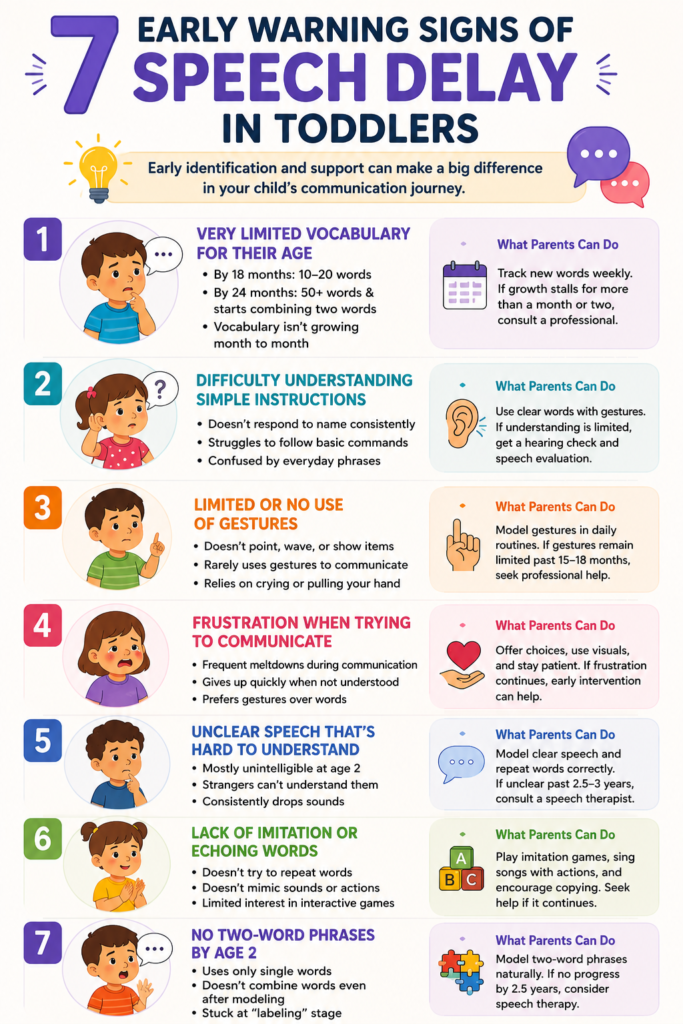
1. Very Limited Vocabulary for Their Age
By 18 months, most toddlers use at least 10–20 words. By 24 months, they typically have 50+ words and start combining two words together (e.g., “more milk,” “mommy go,” “big truck”).indiaparenting+1
What to watch for:
- Your 18-month-old uses fewer than 5–10 words
- Your 2-year-old has fewer than 50 words or isn’t combining words
- Vocabulary isn’t growing month to month
What it could indicate: Possible expressive language concern or speech delay in children.
What parents can do: Track new words weekly. If growth stalls for more than a month or two, discuss with your pediatrician or a qualified speech therapist.
2. Difficulty Understanding Simple Instructions
Receptive language (understanding what others say) often develops before expressive language (speaking). By 18–24 months, most toddlers can follow simple one-step directions like “Give me the ball,” “Come here,” or “Shoes on.”
What to watch for:
- Your toddler doesn’t respond to their name consistently
- They struggle to follow basic commands without gestures
- They seem confused by everyday phrases like “time to eat” or “let’s go outside”
What it could indicate: Possible receptive language delay or hearing concerns.
What parents can do: Use clear, simple language paired with gestures. If understanding remains limited despite consistent modeling, seek a hearing check and speech-language evaluation.
3. Limited or No Use of Gestures
Before words take off, toddlers typically use gestures like pointing, waving, nodding, or reaching to communicate. By 12–15 months, pointing to show interest or request something is common.
What to watch for:
- Your 12-month-old doesn’t point or wave
- Your 18-month-old rarely uses gestures to communicate
- They rely solely on crying, grunting, or pulling your hand instead of pointing
What it could indicate: Communication development may need attention; gestures are a foundation for language.
What parents can do: Model gestures during daily routines (point to objects, wave goodbye, nod yes/no). If gestures remain limited past 15–18 months, consult a speech therapist for kids.
4. Frustration When Trying to Communicate
Toddlers with speech delays often feel frustrated because they understand more than they can express. You might notice tantrums, crying, or giving up when they can’t make their needs known.
What to watch for:
- Frequent meltdowns during communication attempts
- Giving up quickly when you don’t understand them
- Preferring to use gestures over words even when they know the word
What it could indicate: Expressive language gap causing communication breakdowns.
What parents can do: Offer simple word choices (“Do you want milk or water?”), use visual supports (pictures or gestures), and validate their feelings (“I see you’re upset. Let’s figure this out together”). If frustration persists beyond a few weeks, early intervention for speech delay can help.
5. Unclear Speech That’s Hard to Understand
By age 2, familiar listeners (like parents) should understand about 50% of what a toddler says. By age 3, that jumps to 75% or more.
What to watch for:
- Your 2-year-old’s speech is mostly unintelligible, even to you
- Strangers can’t understand anything your child says
- They consistently drop sounds (e.g., “ba” for “ball,” “du” for “duck,” “nana” for “banana”)
What it could indicate: Articulation difficulties or phonological delay.
What parents can do: Model clear speech without pressuring them to repeat. Avoid saying “Say it correctly”—instead, simply repeat the word back clearly (“Yes, that’s a ball!”). If intelligibility remains low past age 2.5–3, seek speech therapy for toddlers.
6. Lack of Imitation or Echoing Words
Toddlers learn speech by imitating sounds, words, and actions they hear. By 15–18 months, most children attempt to copy words or sounds they hear from caregivers.msdmanuals+1
What to watch for:
- Your toddler doesn’t try to repeat words you say
- They don’t mimic sounds (animal noises like “moo,” vehicle sounds like “vroom”)
- Limited interest in interactive games like “peek-a-boo,” “so big,” or “pat-a-cake”
What it could indicate: Possible delays in social communication or auditory processing.
What parents can do: Play imitation games, sing songs with actions, and celebrate any attempts to copy you. If imitation remains limited past 18 months, discuss with a speech-language pathologist.
7. No Two-Word Phrases by Age 2
Combining words into simple phrases (“more juice,” “daddy home,” “big truck,” “mommy up”) is a major milestone around 24 months.indiaparenting+1
What to watch for:
- Your 2-year-old only uses single words
- They don’t combine words even after you model it repeatedly
- Speech remains at the “labeling” stage (naming objects but not using them in context)
What it could indicate: Expressive language delay or grammar development concerns.
What parents can do: Model two-word phrases naturally throughout the day (“Want cookie?” “Ball roll!” “Car go!”). If no progress by 2.5 years, consider speech delay treatment with a qualified professional.
When Should Parents Consider Seeing a Speech Therapist?
If you’ve noticed one or more of the signs above persisting for several weeks—or if your gut tells you something isn’t quite right—it’s worth seeking a professional opinion. You don’t need to wait for a “definitive diagnosis” to explore support.
Consider scheduling an evaluation if:
- Your 18-month-old uses fewer than 10–20 words
- Your 2-year-old isn’t combining two words
- Your toddler’s speech is mostly unintelligible to familiar listeners by age 2.5–3
- They show frequent frustration or withdrawal during communication
- You have ongoing concerns about their speech development in toddlers
Early intervention for speech delay is associated with better outcomes, shorter therapy duration, and reduced frustration for both child and family.
What Causes Speech Delay in Toddlers?
Speech delay in children can stem from various factors—sometimes a single cause, often a combination. Common contributors include:
- Hearing issues: Even mild hearing loss can significantly impact speech development.
- Oral-motor difficulties: Weakness or coordination challenges in the mouth, tongue, or lips.
- Developmental variations: Some children are simply “late bloomers” but catch up with time.
- Neurodevelopmental conditions: ADHD, autism spectrum disorder, or global developmental delay.
- Environmental factors: Limited language exposure, excessive passive screen time, or lack of interactive communication.
- Prematurity or low birth weight: These can affect overall developmental timelines.
- Family history: Speech or language delays often run in families.
Important note: Speaking two languages does not cause speech delay. Bilingual children may mix languages initially, but their total vocabulary across both languages typically matches monolingual peers.
How Can Speech Therapy Help?
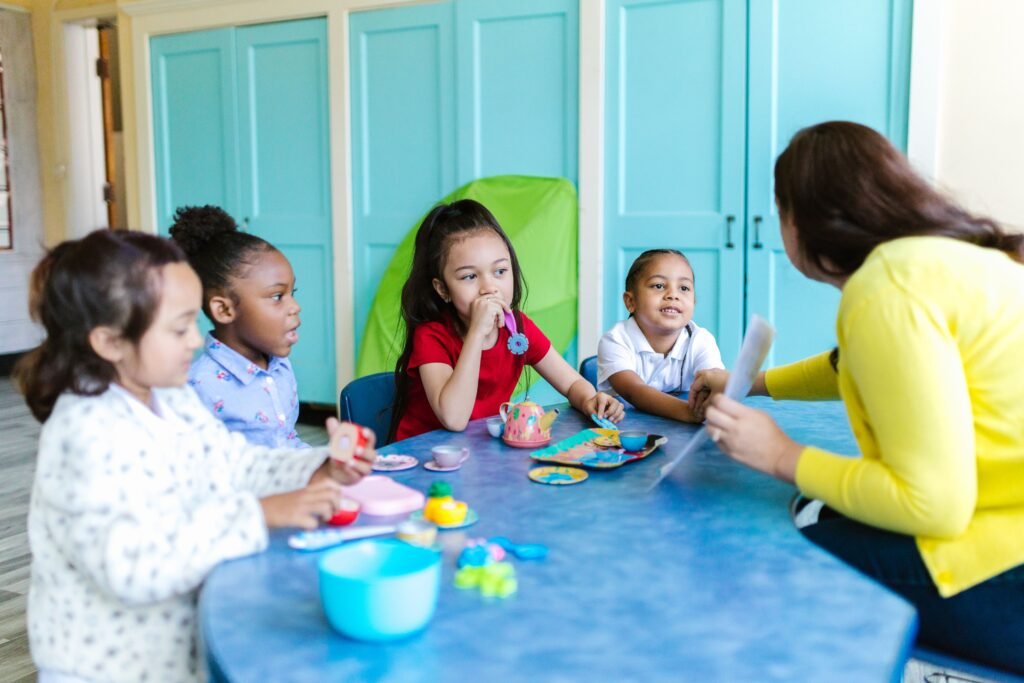
Speech therapy for toddlers is a play-based, child-centered approach that builds communication skills through engaging, age-appropriate activities. A qualified speech-language pathologist (SLP) will:
- Assess your child’s speech, language, and communication abilities
- Identify specific areas of concern (articulation, vocabulary, comprehension, social communication)
- Create a personalized therapy plan with fun, achievable goals
- Teach parents strategies to support progress at home
Therapy sessions might include:
- Articulation exercises to improve sound production
- Language-building activities to expand vocabulary and sentence structure
- Play-based interaction to encourage natural communication
- Parent coaching to reinforce skills during daily routines
Most children show meaningful progress with consistent therapy and home practice.
What Can Parents Do at Home?
While professional support is invaluable, parents play a crucial role in fostering speech development in toddlers. Here are practical, evidence-based strategies you can use daily:
1. Talk, Talk, Talk
Narrate your day: “Now we’re putting on shoes,” “Look at the red car!” Exposure to rich language builds vocabulary naturally.
2. Read Together Daily
Picture books introduce new words, sentence structures, and concepts. Ask simple questions: “Where’s the dog?” “What color is this?”
3. Sing Songs and Rhymes
Nursery rhymes and action songs (like “Itsy Bitsy Spider” or “Wheels on the Bus”) teach rhythm, repetition, and word patterns.
4. Follow Their Lead
Join in what interests them. If they’re playing with blocks, talk about blocks: “Big block!” “Stack it up!” “Tower fell!”
5. Use Simple, Clear Language
Speak in short sentences. Pause to give them time to process and respond.
6. Expand on Their Words
If they say “ball,” you say “Yes, big ball!” or “Roll the ball!” This models longer phrases without pressure.
7. Limit Passive Screen Time
The American Academy of Pediatrics recommends avoiding screens (except video calls) before 18 months and limiting to 1 hour/day of high-quality programming for ages 2–5.
8. Create Communication Opportunities
Put favorite toys slightly out of reach so they need to ask. Offer choices: “Milk or water?” “Red shirt or blue shirt?”

The Importance of Early Intervention
Research consistently shows that early intervention for speech delay leads to:
- Faster progress in therapy
- Better long-term communication outcomes
- Reduced frustration and behavioral challenges
- Improved school readiness and social skills
- Greater confidence in the child
Waiting until age 3 or 4 to “see if they catch up” can mean missed opportunities. If you’re concerned, an evaluation doesn’t commit you to therapy—it simply gives you clarity and options.
FAQs About Speech Delay in Toddlers
What are the early signs of speech delay in toddlers?
Early signs include limited vocabulary for age, difficulty following simple instructions, lack of gestures, unclear speech, frustration when communicating, limited imitation, and no two-word phrases by age 2.
When should I worry about my toddler’s speech?
Consider seeking advice if your 18-month-old uses fewer than 10–20 words, your 2-year-old isn’t combining words, or their speech is mostly unintelligible to familiar listeners by age 2.5–3.
What causes speech delay in toddlers?
Common causes include hearing issues, oral-motor challenges, developmental variations, neurodevelopmental conditions (like ADHD or autism), limited language exposure, and family history. Bilingualism does not cause delay.
What is the difference between speech delay and language delay?
Speech delay involves difficulty producing sounds and words clearly. Language delay involves challenges understanding or using words to communicate. A child can have one, the other, or both.
Can speech therapy help toddlers?
Yes. Speech therapy for toddlers uses play-based, age-appropriate activities to build communication skills. Most children show meaningful progress with consistent therapy and home practice.
At what age should a child see a speech therapist?
There’s no minimum age. If you have concerns, you can seek an evaluation anytime. Many children begin therapy between 18 months and 3 years.
How can parents encourage speech development at home?
Talk frequently, read daily, sing songs, follow your child’s lead during play, use simple language, expand on their words, limit passive screen time, and create opportunities for them to communicate.
Where can I find speech therapy for toddlers?
Look for certified speech-language pathologists in your area. Many pediatric clinics, hospitals, and specialized therapy centers offer speech therapy for toddlers. If you’re searching for speech therapy in Gurgaon, Moonlight Neurocare provide pediatric speech therapy services.
Finding Speech Therapy Support
If you’re concerned about your child’s communication development, you’re not alone—and help is available. When searching for speech therapy for toddlers, look for:
- Certified speech-language pathologists with pediatric experience
- Play-based, child-friendly therapy environments
- Parent involvement and coaching opportunities
- Flexible scheduling and convenient location
For families in Gurgaon or Gurugram, Moonlight Neurocare is a child-focused neurocare and therapy centre that provides speech therapy services for toddlers and children with speech and language concerns. Their team works collaboratively with families to create personalized therapy plans. [Internal link suggestion: speech therapy for children → Speech Therapy page]
If you’re concerned about your child’s speech or communication development and are looking for speech therapy in Gurgaon, you can contact Moonlight Neurocare to learn more about assessment and therapy options available for your child.
Conclusion: Trust Your Instincts and Take the Next Step
Recognizing the signs of speech delay in toddlers isn’t about labeling your child or creating worry—it’s about empowering yourself with knowledge so you can make informed decisions. Every child develops differently, but timely support can make a meaningful difference in their communication journey.
If you’ve noticed several of the warning signs we’ve discussed, or if something just doesn’t feel right, trust your instincts. A conversation with a qualified speech-language pathologist can provide clarity, reassurance, and a clear path forward.
Whether you choose to explore speech delay treatment in your area or seek support elsewhere, remember: you’re not alone, and help is available. With the right guidance, your toddler can build the communication skills they need to thrive—at home, at school, and beyond.
Disclaimer: This article is for educational and informational purposes only and does not constitute medical advice, diagnosis, or treatment. Always seek the advice of a qualified healthcare provider or speech-language pathologist with any questions about your child’s development.
Leave a Reply