
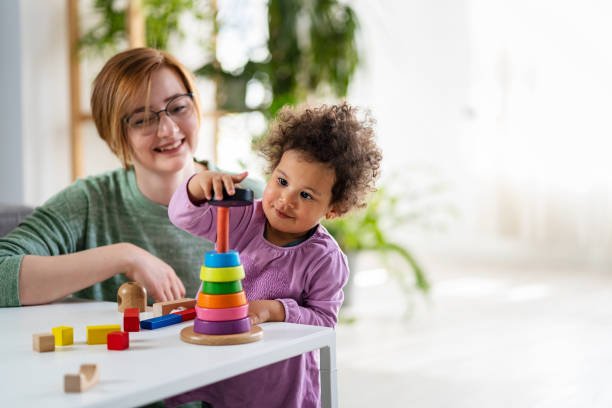
Your 18-month-old is not pointing towards objects like other toddlers his age? Your 2-year-old enjoys playing alone and does not respond to your calls? Do these make you worry? Might he show symptoms of autism?
Each parent wishes that her child develops normally. However, the identification of the signs of autism spectrum disorder in early childhood may be extremely important. In particular, early intervention (which can begin as early as at the age of 18 months) may help in the improvement of communication skills and social interaction.
Autism Spectrum Disorder (ASD)
Autism spectrum disorder (ASD) is a neurodevelopmental disorder that affects the communication skills, social interaction, and behavior of a child. “Spectrum” term in this case implies that ASD affects each child differently: some of them require intensive care while others need minor assistance.
According to research conducted in India, 1 out of 100 children suffer from ASD; however, awareness about it is still growing. In spite of the fact that many children are diagnosed with this disorder only at the age of 3 or 4 years old, its first signs appear at the age of 12-24 months.
Why Early Detection Matters
Early intervention for autism results in the following:
- Enhanced communication and language development
- Social interaction and peer relations improvement
- Behavioral issues reduction
- Improvement of independent skills
- Academic success
The earlier you recognize signs, the sooner your child can access support.
Early Indicators of Autism in Toddlers: Age-Related Checklist
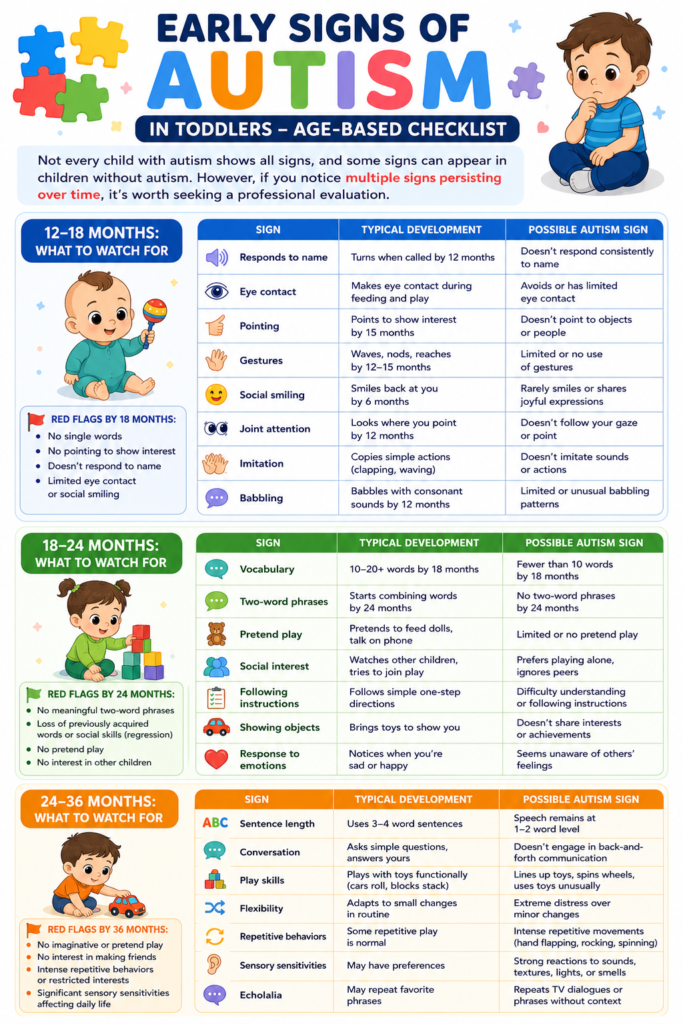
It’s important to note that not all children with autism exhibit all of these symptoms, and some of these symptoms may be present in children who do not have autism at all.
12–18 Months: What to Watch For
| Sign | Typical Development | Possible Autism Sign |
| Responds to name | Turns when called by 12 months | Doesn’t respond consistently to name |
| Eye contact | Makes eye contact during feeding and play | Avoids or has limited eye contact |
| Pointing | Points to show interest by 15 months | Doesn’t point to objects or people |
| Gestures | Waves, nods, reaches by 12–15 months | Limited or no use of gestures |
| Social smiling | Smiles back at you by 6 months | Rarely smiles or shares joyful expressions |
| Joint attention | Looks where you point by 12 months | Doesn’t follow your gaze or point |
| Imitation | Copies simple actions (clapping, waving) | Doesn’t imitate sounds or actions |
| Babbling | Babbles with consonant sounds by 12 months | Limited or unusual babbling patterns |
Symptoms before 18 months of age:
- Not saying any words
- Not using gestures to point at something of interest
- No response to their name
- Lack of eye contact or smiling
18–24 Months: What to Watch For
| Sign | Typical Development | Possible Autism Sign |
| Vocabulary | 10–20+ words by 18 months | Fewer than 10 words by 18 months |
| Two-word phrases | Starts combining words by 24 months | No two-word phrases by 24 months |
| Pretend play | Pretends to feed dolls, talk on phone | Limited or no pretend play |
| Social interest | Watches other children, tries to join play | Prefers playing alone, ignores peers |
| Following instructions | Follows simple one-step directions | Difficulty understanding or following instructions |
| Showing objects | Brings toys to show you | Doesn’t share interests or achievements |
| Response to emotions | Notices when you’re sad or happy | Seems unaware of others’ feelings |
Symptoms after 24 months of age:
- No two-word phrase usage
- Losing any words he/she already knew (regression)
- No pretend activities
- No interest in other kids
24–36 Months: What to Watch For
| Sign | Typical Development | Possible Autism Sign |
| Sentence length | Uses 3–4 word sentences | Speech remains at 1–2 word level |
| Conversation | Asks simple questions, answers yours | Doesn’t engage in back-and-forth communication |
| Play skills | Plays with toys functionally (cars roll, blocks stack) | Lines up toys, spins wheels, uses toys unusually |
| Flexibility | Adapts to small changes in routine | Extreme distress over minor changes |
| Repetitive behaviors | Some repetitive play is normal | Intense repetitive movements (hand flapping, rocking, spinning) |
| Sensory sensitivities | May have preferences | Strong reactions to sounds, textures, lights, or smells |
| Echolalia | May repeat favorite phrases | Repeats TV dialogues or phrases without context |
Symptoms by 36 months of age:
- No imaginative games
- No desire to make friends
- Excessive repetitive actions or restricted interests
- Strong sensory sensitivity
Early Indicators of Autism: Symptoms That Indian Parents Usually Notice
According to parent feedback and clinical observations, these are the most common early indicators of autism Indian parents usually observe:
1. Lack of eye contact
Your toddler does not look at you when you talk, feed, or interact with him. He may look through you or at things rather than people.
2. No Response to Their Name
A normal child turns around when he is called up to him. By 12 months, a child with autism ignores you although his hearing is normal.
3. Delayed or Atypical Language
- No one-word utterances by 16 months
- Two-word phrases no earlier than 24 months
- Echoes words or phrases that make no sense (echolalia)
- Atypical intonation (robot-like, sing-songy or monotonous)
4. Fewer or No Pointing Gestures
Does not use gestures to indicate his needs (no pointing, waving, nodding or reaching). Pulls your hand to the thing that he wants instead of pointing.
5. Preference for Solitary Play
Lack of interest in other children or inability to play with peers.
6. Repetitive Actions
- Hand flapping, finger flicking or body rocking
- Spinning things or himself
- Putting objects in rows or lines
- Viewing the same video over and over again
7. Focused on Particular Objects
Tends to become abnormally attached to certain toys (e.g., wheels, buttons, strings) and carries them everywhere.
8. Strong Resistance to Changes
Very upset when there is any change to his routine, to food or to the environment.
9. Abnormal Reaction to Sensory Stimulation
- Covers his ears to ordinary sounds (e.g., vacuum cleaner, blender)
- Refusal to eat certain textures or wear certain clothing because of the labels
- Likes intense sensation (spinning, jumping, falling)
10. Regression
Some children develop normally up to 15-24 months old and then lose language, social or play skills. It is called autism regression and affects 25-30% of children with ASD.
Autism in Indian Children: Evidence from Recent Studies
The latest Indian studies offer important background knowledge for parents:
- Prevalence: About 1% (1 in 100) children in India are affected with autism spectrum disorders. This prevalence is comparable to other countries.
- Gender difference: The ratio of boys to girls is 3–4:1. Boys may be overdiagnosed because of different symptoms compared to girls.
- Age of onset: Children in India are usually diagnosed with ASD at the age of 3–5 years. However, many signs of autism are present earlier.
- Co-occurring conditions: Many children with autism have co-occurring conditions such as ADHD, speech delays, intellectual disabilities, or sensory processing differences.
Culture-specific aspects: Late talker children in Indian families may be considered the result of God’s will or family genetics. However, it is important to remember that some children are just late bloomers, but others have problems with social and communication development.
Indications for Evaluation
Do not hesitate to visit a professional if you noticed:
- No babbling or gesturing until 12 months of age
- No first words until 16 months of age
- No two-word phrases until 24 months of age
- Regression in speech and social skills at any age
- Several symptoms listed above for 2–3 weeks
Remember that no doctor’s referral is required for the evaluation. You can visit a pediatrician, developmental pediatrician, child psychologist, or speech therapist with experience in diagnosing autism.
What an Autism Evaluation Includes?
An evaluation usually consists of the following components:
- Interview with parents on developmental milestones and current concerns
- Direct observation of your child during the play, interaction, and communication
- Evaluation with standardized tools (ADOS-2, M-CHAT-R for toddlers)
- Hearing and vision screening to exclude other disorders
- Speech and language assessment
- Developmental tests
What If My Child Is Diagnosed with Autism?
A diagnosis can feel overwhelming, but it also opens doors to support. Here’s what helps:
1. Early Intervention Therapy
Evidence-based therapies for toddlers with autism include:
- Speech therapy to build communication skills
- Occupational therapy for sensory and daily living skills
- ABA therapy (Applied Behavior Analysis) for behavior and learning
- Developmental therapies (such as ESDM, JASPER) focusing on naturalistic play
2. Parent Training and Support
Parents are the most important therapists. Learning strategies to support your child at home makes a huge difference.
3. Special Education Services
As your child grows, individualized education plans (IEPs) and inclusive schooling options become important.
4. Community and Family Support
Connecting with other parents, support groups, and advocacy organizations reduces isolation and provides practical guidance.
Conclusion: Early Action Makes a Difference
Recognizing the early signs of autism in toddlers isn’t about labeling your child—it’s about understanding their unique needs and getting them the support they deserve. Every child with autism is different, but early intervention consistently leads to better outcomes in communication, social skills, and independence.
If several signs from this checklist sound familiar, or if your parental instinct tells you something needs attention, trust yourself. A professional evaluation can provide clarity, reassurance, and a clear path forward.
You’re not alone on this journey. With the right support, your child can thrive and reach their full potential.
Visit: moonlightneurocare.com
Contact: +91 7982282025
Leave a Reply